Showing posts with label iraq. Show all posts
Showing posts with label iraq. Show all posts
Non-Corporate Media Stumble
Okay, see how this looks to you:The Obama administration has announced plans to withdraw nearly all U.S. troops from Iraq by the end of the year after failing to reach an agreement with the Iraqi government. The United States had discussed keeping thousands of troops in Iraq, but had insisted their immunity be extended as a pre-condition. After the Iraqi government refused, the
A Great Day to Be Indigenous
There was outrage in Native American circles (and others) recently when it was learned that the mission to take out Osama Bin Laden was codenamed "Operation Geronimo."BoingBoing reported:Even the NYT's account would appear to have inaccuracies now: They report that "Geronimo" was code name for bin Laden, but CNN cites an administration official later clarifying that this was the code name for the
Defending the Indefensible
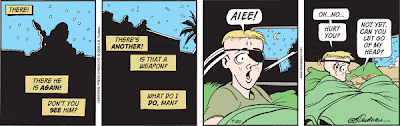 I knew there was something else I meant to write about here, but it kept slipping my mind.
I've always liked Doonesbury, though since I don't regularly read newspapers there have been prolonged periods when I didn't follow the strip closely. For a few years in the 1980s I would just buy each collection as it was published. Now that it's available online, I've done a little better. It was fun to watch certain right-wingers fume when he started up some plots about the Iraq War, with very sympathetic and intelligent portrayals of the troops. When longtime character B.D. lost a leg and his football helmet, a lot of people took notice, but Trudeau has also given serious story time to Leo aka Toggle, an Iraq vet who returns to college after his medical discharge, where he becomes romantically involved with Mike Doonesbury's daughter Alex. Leo lost an eye and has trouble speaking due to Traumatic Brain Injury; he's also a heavy-metal fan who drives a pickup truck. Not exactly the kind of character the Right (or many liberals, alas) would expect to get sensitive kind of treatment in Doonesbury. Which only goes to show how little they know. Sure, Trudeau is a liberal, but he's the kind of liberal that gives liberals a good name.
In last Sunday's strip, Alex and Leo go out for coffee. Alex makes some slighting remarks about some men carrying guns, "open-carry yahoos" as she calls them. (Do such men regularly kick back at Starbucks?) Leo intervenes in the argument: "Listen, dude," he tells one of the men, "I spent two years behind an M60 machine gun defending, among other things, your right to be a moron about guns!" Alex exclaims in delight over Leo's unexpectedly getting out a full sentence.
It's a cute little story, but one thing jumped out at me. Leo was not defending freedom in Iraq. No Iraqi was a threat to Americans' right to be morons about guns. No Iraqi was a threat to American rights or freedoms. It was, and is, our government that is the biggest threat to American rights or freedoms -- remember the Patriot Act, which was passed under Bush but was originally a Clinton-era project? -- and it was in the service of that government that Leo and thousands of other soldiers went to Iraq.
I know, I know, what he said was in character. For that matter, the latest Doonesbury collection, Signature Wound, has a Foreword retired US Marine Corps General and Joint Chiefs of Staff Chairman Peter Pace, who hails "all who have stepped forward and volunteered to protect the freedoms we hold dear." Such talk is a conditioned reflex, not only in the military but among most people who can't quite bring themselves to object to any war the US starts. I must respectfully but firmly differ with the General, and with Leo, and with Garry Trudeau if it comes to that. The United States has not fought a defensive war in my lifetime, and I was born in 1951. With all proper sympathy and empathy for those who feel the need to rationalize and justify their participation in the wars of aggression we have fought and are fighting now, I can't go along with them on this point. As far as I can see, until Americans can recognize what their government and their armed forces are doing, we will continue to get involved in these wars, and that will mean more young people getting chewed up and spat out by the military, with more or less support from their society. (Not to mention the vastly greater numbers of innocent foreigners who suffer.) But the best way -- the only way, really -- to support them is not to damage them in the first place.
P.S. May 9, 2010: Oh, dear, here's another one. (Via)
I am a homosexual American citizen and while I fight to defend the rights of free speech and a democratic legislature process, I suffer because these very same freedoms are denied to me as a gay Sailor.Again, this is mere rhetoric (read the whole letter for his account of the highlights of his service). Which, as I've said before, doesn't mean the ban on gays in the military shouldn't be lifted, only that it has nothing to do with defending anyone's rights.
P.P.S. May 16, 2010: This one from the Give a Damn Campaign's website, an open letter to President Obama from a gay soldier on leave from deployment in Iraq:
When serving in a war zone, you learn quite a bit about yourself and what’s important to you. I’ve had the chance to work on a close and personal level with the people of Iraq, and in doing so, I have realized more than ever that the freedoms we enjoy as Americans should not be taken for granted – we must protect them at all costs. These freedoms are essential to the very foundation of our society. Yet so many men and women who fight for these freedoms aren’t allotted their own. Our freedom to love and be loved by whomever we choose. The freedom to live of a life of truth and dignity.I wonder if it's possible to talk about an issue like this without relying on such pious garbage. But this young man isn't protecting my freedoms, or your freedoms, or anyone else's freedoms. If anything, he's fighting for a state that is dedicated to taking freedom away. (In an exchange on the Campaign's Facebook pages, one guy inadvertently came closer to reality: "I'm gay, and I would love to serve my military..." (But then I noticed that "Serving the Military" is the thread topic; I can't even give this poor kid credit for the Freudian slip.)
Defending the Indefensible
I knew there was something else I meant to write about here, but it kept slipping my mind.I've always liked Doonesbury, though since I don't regularly read newspapers there have been prolonged periods when I didn't follow the strip closely. For a few years in the 1980s I would just buy each collection as it was published. Now that it's available online, I've done a little better. It was fun to
Duty, Honor, Country
 I finished reading Tamler Sommers's A Very Bad Wizard yesterday, but I'll probably be writing about it for a while to come. Certain themes keep turning up, as in the concluding interview with law professor William Ian Miller about societies based on honor. In his introduction to the session Sommers writes (208),
Many Arab and Islamic societies are thought to be honor cultures, and as a result research on this topic has attracted the attention of political and military strategists. Former US Army Major William McCallister, for example, has attributed the US's initial unpopularity with Iraqis during the Iraq War to, in part, our failure to grasp the pervasive role that the concepts of shame and honor play in Iraqi society; they are as important to the Iraqis as land and water. McCallister, who now consults with the Marines in Iraq, writes that "It has taken us four years to realize that we must execute operations within the existing cultural frame of reference."(The link to McCallister is given by Sommers in a footnote. It's amusing, in the same way that having a finger shoved down your throat is amusing. Among McCallister's recommended readings are Eric Hoffer's The True Believer, which I must reread soon and write about here; Bernard Lewis's The Multiple Identities of the Middle East; Kanan Makiya's long-discredited Republic of Fear; and The Code of Hammurabi, translated by L. W. King.)
So, really? The US was initially unpopular (well, "in part") because of "our failure to grasp the pervasive role that the concepts of shame and honor play in Iraqi society." That the US had invaded Iraq, devastated the country, killed and injured thousands of Iraqis, installed a corrupt gangster as our local puppet -- none of this, and more, rates a mention. (Though as I recall, many Iraqis did initially welcome the US invasion for dislodging Saddam Hussein from power -- but they didn't want us to stick around afterward. That seemed reasonable to me at the time, but now I realize that I misunderstood their honor culture.)
In the body of the interview (which is actually pretty interesting; I may look up Miller's writing on honor in the Icelandic sagas), Sommers brings up the subject of Iraq as follows (224):
TS: ... Let me put it like this: you see in reports from Iraq that some officers come back almost bewildered by the honor codes. One former army guy said that honor and shame are their moral currency, and that until we understand that, we're screwed. Do you think a general misunderstanding of honor cultures has led to (honest, in a way) mistakes, like thinking we'll be greeted as liberators, or that we can establish a democracy without too much pain and loss of life?Miller's initial comment is good: it's true, career military officers live in an honor culture -- but he doesn't question Sommers's delusions about US motives in Iraq. I have to remind myself that for these guys, the fact of the invasion, the aggression, is simply off the table; they don't even ignore it, because that would mean being aware in some way that it's there and it's a problem. Just as in Sommers's interview with Joseph Henrich, there is no question that the US, in its honest but bumbling way, was trying to "liberate" Iraq, to "establish a democracy without too much pain and loss of life." (Noam Chomsky likes to tell how the original Great Seal of the Massachusetts Bay Company "depicts an Indian with a scroll coming from his mouth pleading 'Come over and help us.' The charter states that rescuing the population from their bitter pagan fate is 'the principal end of this plantation.'") Only the pacifists, the isolationists, the reflexive opponents of the Republicans or the US military would dwell on such trivial irrelevancies. Nor can Sommers and Miller begin to imagine, apparently, that Iraqis might see it any differently.
WIM: It isn't honor culture the officers don't understand; hell, they live in one. It's the particular substantive matters that trigger honor concerns in Iraq -- just what precisely they will take as a big offense and what they'll shrug off. That's where the misunderstandings take place.
The pattern is familiar: we tried to help the Iraqis / Vietnamese / Haitians / Filipinos / name your favorite recipient of Euro-American assistance, to bring them democracy, freedom, Christianity, but they just aren't ready for democracy. Their values, their "norms," are different from ours, and that's "where the misunderstandings take place." Even worse, they are crafty, deceptive, corrupt and irresponsible, and we simple, innocent, direct Americans don't know how to cope with their devious ways. We're the New World -- fresh, scrubbed, untouched by Old World wickedness -- so how could we possibly understand them?
One thing that doesn't get covered in the interview, unfortunately: Sommers mentions in the introduction that among the topics covered in his more than three hour gabfest with Miller was "the appalling hypocrisy of the Israeli University boycott" (209). I guess he means this? I feel sure that Sommers's take on the matter would be every bit as profound as his understanding of Iraqis' reaction to the US coming over to help them.
Duty, Honor, Country
I finished reading Tamler Sommers's A Very Bad Wizard yesterday, but I'll probably be writing about it for a while to come. Certain themes keep turning up, as in the concluding interview with law professor William Ian Miller about societies based on honor. In his introduction to the session Sommers writes (208),Many Arab and Islamic societies are thought to be honor cultures, and as a result
But Enough About You ...
This article – well, really it’s only a squib – by one Megan McArdle has been linked by IOZ (in a strong, eloquent post), if not by others, on the web. It’s interesting to watch Ms. McArdle squirm: Obviously, there are people who were right about the war for the right reasons, and we should examine what their thought process was--not merely the conclusions they came to, but how they got there.
Subscribe to:
Posts (Atom)